
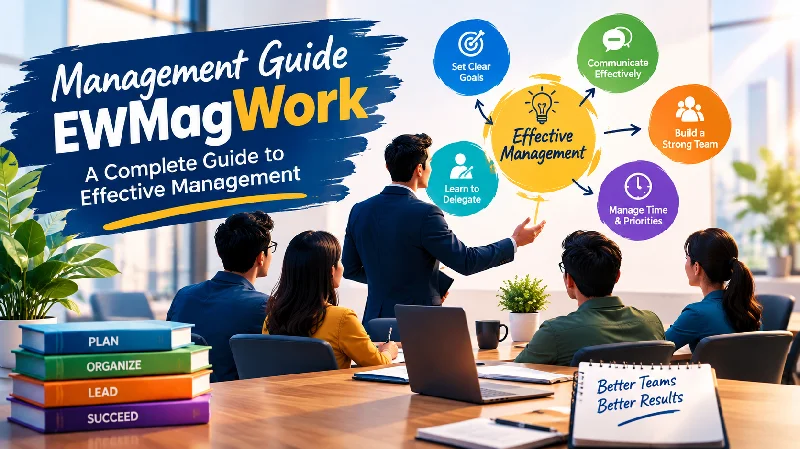
Effective management is one of the most important factors behind the success of any organization, business, or professional team. Whether you are managing employees, projects, daily operations, or your own workload, having the right management approach can improve productivity, communication, and overall performance.
The management guide ewmagwork provides a useful framework for understanding the key principles of modern management and applying them in practical situations. From planning and delegation to communication and performance improvement, good management is built on consistent and organized practices.
What Is Management?
Management is the process of planning, organizing, directing, and controlling resources to achieve specific goals. These resources can include employees, time, money, technology, information, and other business assets.
A successful manager does more than simply assign tasks. A manager helps people understand their responsibilities, removes obstacles, communicates expectations, monitors progress, and supports the team in achieving common objectives.
Why Is Effective Management Important?
Good management can have a direct impact on workplace performance. When employees understand their roles and goals, they are more likely to work efficiently and contribute positively to the organization.
Some major benefits of effective management include:
- Better employee productivity
- Clearer communication
- Improved teamwork
- More efficient use of resources
- Better decision-making
- Stronger accountability
- Improved project organization
- Greater employee engagement
- Faster identification of problems
For this reason, understanding practical management principles is valuable for both experienced managers and people who are preparing for leadership responsibilities.
Management Guide EWMagWork: Key Principles
The management guide EWMagWork can be understood through several fundamental management principles. These principles provide a practical foundation for handling teams, projects, and business responsibilities.
1. Set Clear Goals
Every successful management process begins with clear goals. Employees should know what they are expected to accomplish and why the goal matters.
Instead of setting vague objectives, managers should define goals that are specific, measurable, realistic, relevant, and time-bound.
For example, rather than saying “increase sales,” a manager could establish a goal to increase qualified sales leads by a specific percentage within a defined period.
Clear goals make it easier to measure progress and identify areas that need improvement.
2. Communicate Effectively
Communication is at the center of effective management.
Managers should communicate expectations, deadlines, responsibilities, changes, and feedback clearly. At the same time, effective communication requires listening to employees and understanding their concerns.
Useful communication practices include:
- Regular team meetings
- Clear written instructions
- One-on-one discussions
- Constructive feedback
- Active listening
- Open communication channels
Poor communication can create confusion, duplicated work, missed deadlines, and unnecessary workplace conflict.
3. Learn to Delegate
Delegation is an essential management skill. Trying to handle every responsibility personally can reduce productivity and prevent employees from developing their own skills.
Effective delegation involves assigning the right task to the right person while providing the necessary resources and authority to complete it.
A good manager should consider an employee’s:
- Skills
- Experience
- Workload
- Availability
- Development goals
Delegation does not mean simply giving someone more work. It means distributing responsibilities strategically so the entire team can perform effectively.
4. Manage Time and Priorities
Time management is another important part of successful management.
Managers often have multiple tasks competing for attention. Prioritizing responsibilities helps ensure that important work receives attention before less critical activities.
A simple approach is to divide tasks into categories such as:
- Urgent and important
- Important but not urgent
- Urgent but less important
- Neither urgent nor important
Using calendars, task-management systems, project boards, and checklists can also help managers maintain control over deadlines.
5. Build a Strong Team
A manager’s success is closely connected to the performance of the team.
Building a strong team requires more than hiring talented people. Managers need to create an environment where employees understand their responsibilities, cooperate with colleagues, and feel comfortable sharing ideas.
Team-building can be improved through:
- Clearly defined roles
- Shared objectives
- Respectful communication
- Recognition of good work
- Constructive feedback
- Opportunities for professional development
When people understand how their individual responsibilities contribute to a larger objective, teamwork can become more effective.
6. Monitor Performance
Effective managers need a way to understand whether work is progressing as expected.
Performance monitoring should focus on meaningful results rather than unnecessary micromanagement. Managers can use measurable indicators, project milestones, quality standards, customer feedback, and regular reviews to evaluate progress.
If performance falls below expectations, the manager should first identify the underlying issue.
Possible causes may include:
- Unclear instructions
- Insufficient training
- Unrealistic deadlines
- Lack of resources
- Workload problems
- Communication issues
Finding the cause makes it easier to develop an appropriate solution.
7. Give Constructive Feedback
Feedback helps employees understand what they are doing well and where they can improve.
Effective feedback should be specific, timely, and focused on behavior or results rather than personal criticism.
For example, instead of saying:
“You need to improve your work.”
A manager could explain:
“The report contains useful information, but the data sources need to be clearly identified before the final version is submitted.”
Specific feedback gives employees something practical they can act upon.
8. Make Better Decisions
Decision-making is a major responsibility of management.
A structured decision-making process can help managers avoid unnecessary mistakes. Before making an important decision, consider:
- What is the actual problem?
- What information is available?
- What options exist?
- What are the potential benefits and risks?
- Who will be affected?
- What resources are required?
- How will success be measured?
Not every decision requires extensive analysis. However, important decisions should be based on relevant information rather than assumptions.
9. Handle Workplace Problems Professionally
Problems are normal in every organization. Conflicts, missed deadlines, resource limitations, and misunderstandings can occur even in well-managed teams.
The goal of management is not to eliminate every problem but to address problems efficiently.
When a problem occurs, managers can:
- Identify the issue.
- Listen to the people involved.
- Collect relevant information.
- Identify the underlying cause.
- Discuss possible solutions.
- Agree on practical next steps.
- Follow up afterward.
A calm and systematic approach can prevent small issues from becoming larger problems.
10. Encourage Continuous Improvement
Effective management should not remain static. Businesses, technologies, customer expectations, and workplace requirements change over time.
Managers should regularly ask:
- What is working well?
- What is causing delays?
- Which processes can be simplified?
- What feedback are employees providing?
- Are current goals still relevant?
- What can we improve next?
Small improvements made consistently can create significant long-term results.
Common Management Mistakes to Avoid
Even experienced managers can make mistakes. Some common problems include:
Micromanagement
Constantly controlling every small task can reduce employee independence and motivation. Managers should provide direction and accountability while allowing capable employees to perform their responsibilities.
Unclear Expectations
Employees cannot consistently meet expectations they do not understand. Responsibilities, deadlines, and quality standards should be communicated clearly.
Poor Listening
Management is not only about speaking. Listening to employees can reveal problems, ideas, and opportunities that managers might otherwise miss.
Ignoring Feedback
Feedback should be treated as useful information. Managers who consistently ignore reasonable concerns may miss opportunities to improve workplace processes.
Failing to Recognize Good Work
Recognition does not always need to be financial. Acknowledging strong performance, progress, creativity, or teamwork can contribute to a positive workplace environment.
How to Improve Your Management Skills
Management skills develop through practice and continuous learning. A practical improvement plan can include:
Step 1: Evaluate your current approach.
Identify your strengths and weaknesses as a manager.
Step 2: Improve communication.
Practice clear instructions, active listening, and constructive feedback.
Step 3: Strengthen delegation.
Learn to distribute responsibilities according to skills and priorities.
Step 4: Use measurable goals.
Define outcomes that can be tracked over time.
Step 5: Review performance regularly.
Look at both successful results and areas that need improvement.
Step 6: Learn from experience.
After completing a project, review what worked and what should be changed.
Management Guide: EWMagWork for Modern Workplaces
Modern workplaces often involve remote teams, digital tools, flexible schedules, and employees working across different locations. This makes organized management even more important.
Managers may need to combine traditional leadership principles with digital collaboration tools. Project-management platforms, communication applications, shared documents, calendars, and performance dashboards can make coordination easier when used appropriately.
However, technology should support management rather than replace good communication and leadership.
Final Thoughts
Effective management is a continuous process rather than a single skill. Strong managers plan carefully, communicate clearly, delegate appropriately, monitor meaningful results, solve problems professionally, and help their teams improve.
The management guide ewmagwork offers a useful framework for understanding these fundamental principles. By applying them consistently and adapting them to the needs of a particular workplace, managers can create more organized processes and help teams work toward their goals more effectively.
The most important principle is simple: good management combines clear direction with effective communication, accountability, and continuous improvement.
Frequently Asked Questions
What is the management guide ewmagwork?
The management guide ewmagwork refers to a practical approach to understanding and applying important management principles, including planning, communication, delegation, teamwork, performance management, and continuous improvement.
Why is management important in a business?
Management helps organizations coordinate people and resources toward common goals. Effective management can improve productivity, communication, accountability, and operational efficiency.
What are the most important management skills?
Important management skills include communication, delegation, decision-making, planning, problem-solving, time management, conflict resolution, and leadership.
How can a new manager become more effective?
A new manager can improve by setting clear expectations, listening to employees, learning to delegate, providing useful feedback, tracking meaningful results, and continuously reviewing their management approach.
Is management only about managing employees?
No. Management can involve people, projects, resources, time, processes, budgets, and organizational goals. Effective management coordinates these elements to achieve desired results.