
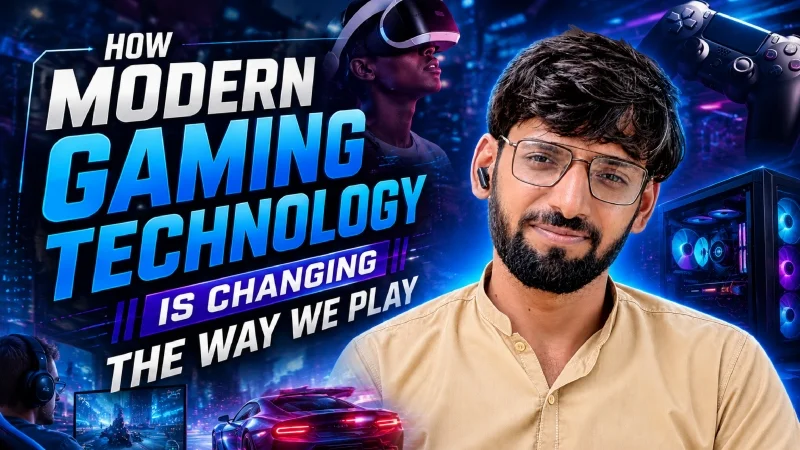
Gaming has transformed dramatically as technology has advanced. What once involved simple graphics and limited gameplay has become an interactive digital experience powered by artificial intelligence, cloud computing, high-performance hardware, faster networks, and sophisticated software.
Today, gaming is closely connected with many areas of technology. Developers use advanced tools to create realistic environments, while players benefit from faster loading times, improved graphics, online connectivity, and increasingly intelligent gameplay systems. Understanding these developments helps explain why modern gaming continues to attract millions of players worldwide.
The Evolution of Modern Gaming Technology
The earliest video games operated under significant hardware limitations. Developers had to create engaging experiences with basic graphics, limited memory, and simple processing capabilities.
Modern gaming systems are completely different. Powerful processors and graphics cards allow developers to build large environments with detailed characters, realistic physics, advanced lighting, and complex artificial intelligence.
At the same time, improvements in storage technology have reduced loading times, while internet connectivity allows developers to continuously update games after release.
Key Technologies Driving Modern Gaming
Several technologies are contributing to the rapid development of the gaming industry. Each one affects the player experience in a different way.
| Technology | Role in Gaming | Main Benefit |
|---|---|---|
| Artificial Intelligence | NPC behavior and development assistance | Smarter gameplay |
| Cloud Computing | Remote game processing and online services | Greater accessibility |
| High-Speed Networking | Multiplayer connectivity | Lower latency |
| Advanced GPUs | Graphics rendering | Better visual quality |
| SSD Storage | Faster game loading | Reduced waiting times |
| Open-Source Software | Development and compatibility | Greater flexibility |
Together, these technologies are helping developers create experiences that were difficult or impossible to achieve with older gaming hardware.
How Artificial Intelligence Is Improving Games
Artificial intelligence is becoming an increasingly important part of game development. Developers can use AI to improve non-player character behavior, analyze testing data, assist with development tasks, and create more responsive gameplay systems.
Traditional NPCs often followed predictable patterns. Modern AI systems can allow characters to react to player actions and changing situations. This can make gameplay feel less repetitive.
AI can also help development teams identify bugs and analyze large amounts of gameplay information. However, human creativity remains essential because designers still determine the story, mechanics, artistic direction, and overall player experience.
Cloud Gaming Is Changing Accessibility
Cloud computing has introduced another important change. Instead of depending entirely on local hardware, cloud gaming services can process games on remote servers and stream the results to compatible devices.
This model can make demanding games more accessible to users who do not own expensive gaming hardware. Players may be able to access high-quality experiences using supported computers, smartphones, or other devices.
However, cloud gaming depends heavily on internet quality. A stable connection and low latency are important because delays can negatively affect interactive gameplay.
Faster Networks and Multiplayer Gaming
Online multiplayer games require reliable communication between players and servers. Faster internet connections and improved network infrastructure have therefore become essential to modern gaming.
Low latency is particularly important for competitive games. A noticeable delay can affect movement, aiming, and timing. Developers continue to improve server locations, matchmaking systems, and network optimization to provide smoother multiplayer experiences.
Modern connectivity has also contributed to the growth of cross-platform gaming, allowing players on different compatible systems to participate in the same online communities.
The Role of Linux and Open-Source Technology
Linux and open-source software have become valuable parts of the broader gaming ecosystem. Linux provides developers and technology enthusiasts with a flexible environment for programming, testing, server management, and software experimentation.
Open-source projects can also contribute to compatibility tools, graphics technologies, development frameworks, and community-driven solutions.
For gamers who enjoy understanding the technology behind their favorite software, Linux offers an opportunity to explore how operating systems, drivers, hardware, and applications interact.
Technology-focused resources such as PBLinuxTechBlogs can also help readers explore broader topics surrounding Linux, gaming, programming, AI, and modern computing.
Advanced Graphics Are Creating Immersive Experiences
Graphics technology has progressed significantly. Modern GPUs can render detailed environments, realistic lighting, complex shadows, and advanced visual effects in real time.
Ray tracing is one example of a technology that can create more realistic lighting and reflections. Meanwhile, modern upscaling techniques can improve performance by producing high-quality images without requiring every frame to be rendered at the highest native resolution.
These improvements are not simply about visual appearance. Better graphics technology can help developers create environments that feel more believable and interactive.
Why Gaming Hardware Still Matters
Software is only one part of the gaming experience. Hardware still determines how efficiently games can run.
Modern gaming computers and consoles use powerful processors, advanced graphics hardware, high-speed memory, and solid-state storage. SSDs have become particularly useful because they can dramatically reduce loading times compared with traditional hard drives.
Gaming peripherals have also evolved. High-refresh-rate monitors, responsive controllers, mechanical keyboards, and advanced audio equipment can improve precision and immersion.
The Growth of Cross-Platform Gaming
Cross-platform gaming is becoming increasingly important as players use different devices. Allowing compatible platforms to share multiplayer environments can create larger communities and make matchmaking easier.
However, cross-platform development presents technical challenges. Developers must consider hardware differences, control systems, performance levels, security, and platform-specific requirements.
When implemented effectively, cross-platform gaming can give players greater flexibility while helping developers maintain larger and more active communities.
What the Future of Gaming Technology May Bring
Gaming technology will likely continue to evolve as AI, cloud computing, networking, graphics hardware, and open-source development advance.
Future games may feature more responsive virtual characters, dynamic environments, personalized gameplay systems, and improved accessibility. Developers may also find new ways to combine cloud infrastructure with local hardware to deliver more flexible gaming experiences.
The gaming industry is increasingly connected to fields such as software engineering, cybersecurity, artificial intelligence, networking, and hardware development. As a result, innovations created for gaming can influence technology beyond entertainment.
Final Thoughts
Modern gaming is an excellent example of how multiple technologies can work together to create increasingly sophisticated digital experiences. Artificial intelligence can improve gameplay, cloud computing can expand accessibility, faster networks can support multiplayer communities, and advanced hardware can deliver better performance and visuals.
Linux and open-source technologies also contribute to this changing ecosystem by providing flexible tools and environments for developers and enthusiasts.
As these technologies continue to improve, gaming will likely become more immersive, connected, and accessible. For technology enthusiasts, following these developments provides a useful way to understand how modern computing continues to shape digital entertainment.